A slab can look impressive in a showroom and still create failures during cutting, installation, cleaning, or handover. You will learn how to separate acceptable mineral movement from rejectable damage, inspect the actual lot, match slabs to their intended locations, and set supplier and fabrication controls before money is committed.
Key takeaways
- Reject slabs with cracks, unstable repairs, or insufficient usable area.
- Check thickness, dimensions, resin, polish, shade, and lot consistency before purchase.
- Allocate matching slabs to visible areas and reserve extras for replacement.
- Ask Pune suppliers for lot photos, inspection records, and written tolerances.
Which Alaska White Granite Defects Create the Greatest Commercial Risk?
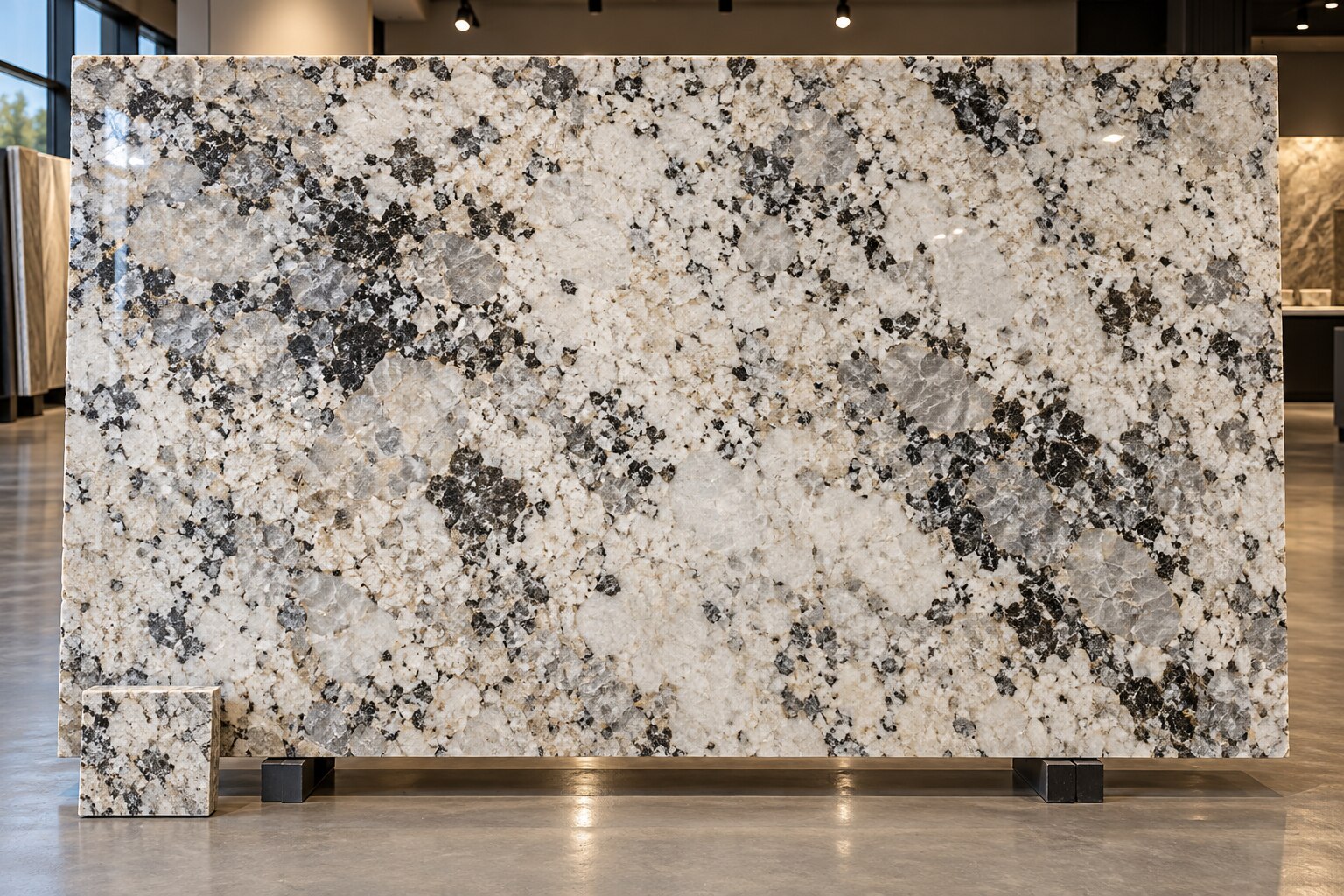
The greatest commercial risk comes from defects that affect structural integrity, repeated appearance, or usable fabrication area—not ordinary mineral movement. Alaska White is a commercial stone name, not a precise quality specification; blocks and production lots vary in movement, thickness, resin treatment, and polish.
| Defect | What to distinguish | Commercial consequence |
|---|---|---|
| Open fissures or structural cracks | A stable natural fissure differs from a crack that separates, continues through the slab, or opens at an edge. | Breakage, rejected slabs, unusable cut-outs, and replacement disputes. |
| Open pits, resin-filled cracks, or cloudy repairs | Check whether pits remain open and whether resin appears as dark lines, glossy spots, or cloudy patches. | Visible repairs can fail an approved elevation or become prominent beside clean slabs. |
| Mineral staining and deep brown or burgundy patches | Black and brown mineral movement may be normal; a distracting patch in a repeated elevation is not. Brown staining after wetting signals a greater concern. | Mismatched elevations, disputed appearance, and rework. |
| Inconsistent white or grey background colour | Compare the actual slabs from one lot, not a small showroom sample. | Adjacent panels, counters, or vanities may not match. |
| Weak or bruised edges, warpage | Inspect edges, corners, and flatness; damage can worsen during cutting or installation. | Chipped mitres, failed cut-outs, difficult alignment, and unusable pieces. |
| Polished scratches or dull areas | Angled light exposes uneven reflection and fabrication marks. | Visible finish rejection after installation. |
Record accepted variation in the tender and approve the physical lot. Otherwise, a visually acceptable slab can still trigger rejected slabs and a replacement dispute.
How Do You Perform an Alaska White Granite Quality Check Before Purchase?
An Alaska White Granite quality check must approve the actual production lot, not a showroom sample. Inspect every reserved slab at a low angle under strong, bright light, covering the complete face rather than only the display section.
Use this lot-specific sequence:
- Wet the slab to reveal porous zones, resin-repaired cracks, cloudy fills, and mineral staining.
- Check the underside, edges, corners, sink and hob cut-outs, and exposed cut-out margins for defects that continue through the stone.
- Measure actual thickness at several points and check flatness with a straightedge. Record edge bruising, chips, warpage, scratches, dull patches, and inconsistent polish.
- Place slabs from the same lot side by side. Reject unexplained differences in white or grey background, movement, burgundy patches, or repair visibility.
A small sample cannot approve a large floor, repeated vanity, staircase, or façade because the usable clear area, colour pattern, thickness, and hidden repairs can change across the lot.
| Approval basis | What it reveals | Commercial consequence |
|---|---|---|
| Showroom sample | General colour and movement only | Cannot predict lot-wide matching or cut-out margins |
| Full dry inspection | Cracks, pits, bruises, scratches, polish variation | Identifies visible rejection risks |
| Wet and reverse-side inspection | Porosity, repairs, through-defects, staining | Prevents unusable fabricated pieces |
Before cutting, require the physical production lot, individual slab numbers, dated photographs, and a signed control slab or approved slab record. Keep these documents with the purchase order.
Which Commercial Applications Are Most Exposed to Alaska White Granite Project Issues?
Large floors, façades, wet areas, and stairs carry the highest Alaska White granite project issues because failure affects safety, repeated modules, or entire elevations. Assess each application instead of treating every slab as interchangeable.
| Application | Main exposure | Review before approval |
|---|---|---|
| Large floors, entrances, washrooms, ramps, and food-service areas | Wear, scratches, uneven slabs, and wet slip | Check finish durability, flatness, and the specified wet-slip test and acceptance value. Polished stone is not automatically suitable; compare honed, flamed, brushed, or textured finishes. |
| Reception and kitchen counters | Stains, broken cut-outs, unstable edges, and visible repairs | Confirm clear sink and hob cut-out margins, edge stability, stain resistance, and compatibility between the slab and adhesive. |
| Stair treads | Bending, nosing damage, and slipping | Review span, thickness, support, nosing detail, exposed-edge strength, and wet-slip performance. |
| Wet areas, sinks, façade joints, and exterior openings | Brown iron-related staining after wetting and drying | Test the actual slab with the proposed sealer, adhesive, grout, cleaner, and water exposure. Construction water can expose staining that a dry inspection misses. |
| Wall cladding and façades | Panel weight, wind load, movement, drainage, and anchor failure | Engineer mechanical anchorage under ASTM C1242, including anchor edge distances. Adhesive alone is not a structural façade system. |
Request lot-specific ASTM C97/C97M absorption and bulk specific gravity, ASTM C170/C170M compressive strength, and ASTM C880/C880M flexural strength reports. ASTM C615/C615M addresses granite dimension stone, but no test report replaces project-specific review of thickness, span, support, traffic, finish, exposure, and fixing method. These are essential controls for alaska white granite project issues.
How Should a Commercial Team Select, Test, and Allocate the Slabs?
This sequence targets Alaska White granite problems commercial projects in Pune face: approve the actual lot before cutting, then control every slab through fabrication and installation.
1. Approve a full-size, or sufficiently large, sample with the intended finish. Honing, leathering, flaming, and brushing reduce reflection and can increase mineral contrast, while making resin fills, micro-pits, and fabrication marks easier to see. Do not approve a honed floor or stair from a polished sample.
2. Test the actual slab with the proposed sealer, adhesive, grout, cleaner, and water exposure. Use a white or stone-compatible adhesive where the light slab requires it; dark adhesive can create shadowing or translucent patches. Approve a mock-up using the exact slab, substrate, adhesive, grout, cleaning regime, and curing conditions before bulk fabrication.
3. Reserve matching slabs for every planned elevation, counter, floor, stair, and panel, plus future repairs. Map each slab to its location and record its production lot and slab number. A replacement from a later lot may not match the original background or mineral movement.
4. Inspect at fabrication and installation: measure thickness and flatness, verify cut-outs and edge margins, and check mitres, exposed edges, chips, repairs, and surface damage. Put acceptable fissures, filled areas, colour variation, and rejection tolerances in the tender documents.
A visually acceptable slab still fails when its usable clear area cannot support the required cut-out or repeated module.
What Should You Ask an Alaska White Granite Supplier in Pune Before Ordering?
A showroom slab proves appearance, not traceability or replacement capacity. Use this checklist when comparing an Alaska White granite supplier in Pune:
1. What quarry block or production-lot identification applies to this order, and what are the individual slab numbers? Ask for reserved-slab photographs and permission to inspect every slab before cutting.
2. What dimensions are available, and what are the measured thicknesses and permitted tolerances? Confirm the finish, resin treatment, visible repairs, polished areas, pits, and edge condition in writing.
3. Can you provide recent, lot-specific ASTM test reports? Treat ASTM C615/C615M results as material evidence, not project approval; a generic certificate cannot confirm this lot’s colour, repairs, thickness, or suitability.
4. Who protects the slabs during packing and transport? Confirm delivery timing, unloading responsibility, inspection at receipt, and the written procedure for replacing cracked, stained, transit-damaged, or mismatched slabs.
5. How many additional slabs from the same block or lot remain available for future repairs? Confirm that the supplier will retain slab photographs, lot details, and the signed approved control record for the project.
RK GRANITE or any other supplier should answer these questions before commercial approval. Do not release cutting based on a small showroom display, a verbal promise, or a generic certificate; approve the actual reserved material and preserve a documented replacement route.
Related product
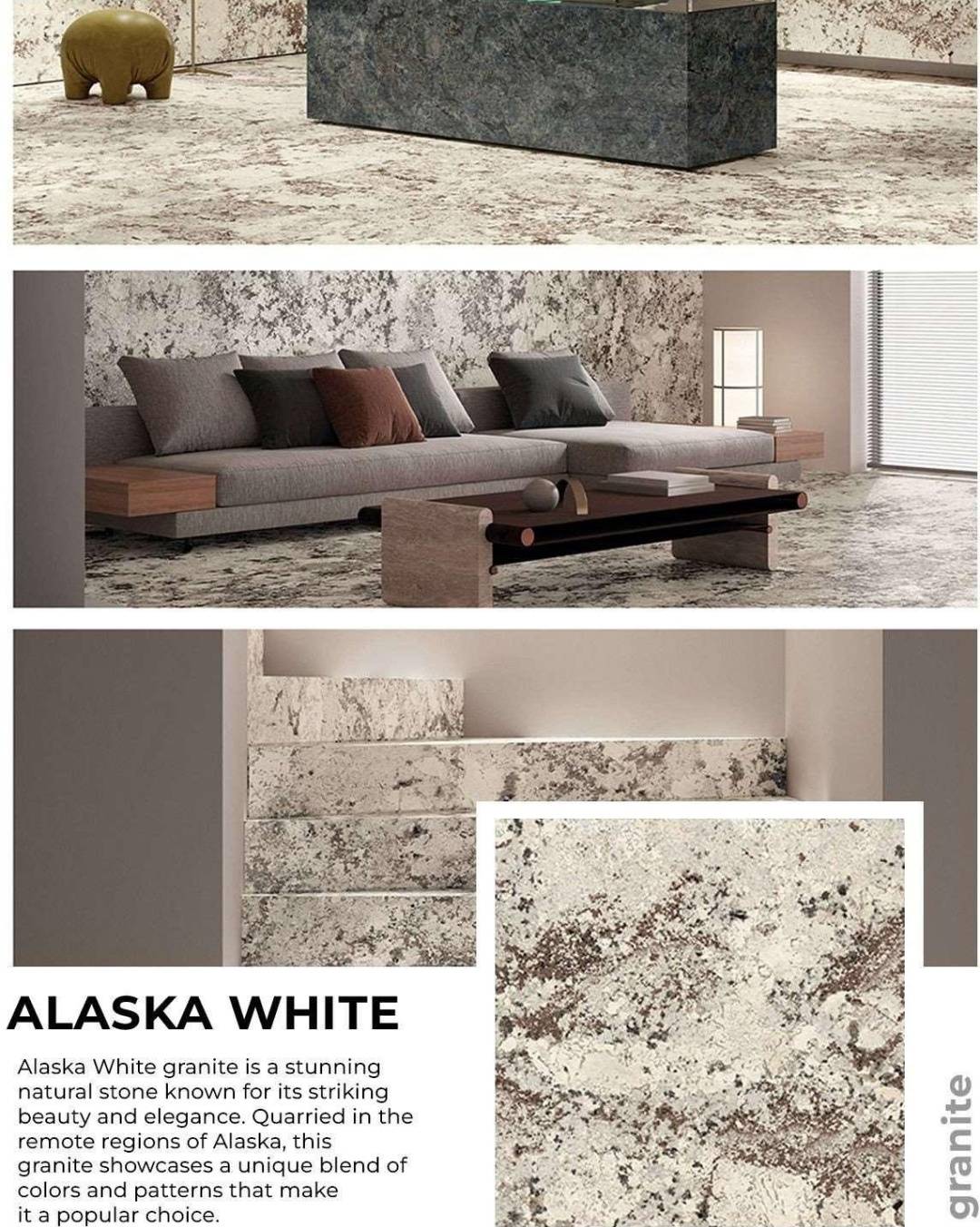 | Granite RK Granite offers premium Alaska White Granite in Pune, a luxurious stone known for its white and light grey background with striking black and brown... View product → |
Frequently asked questions
Which Alaska White granite defects create the greatest commercial risk?
Cracks, poorly repaired fissures, excessive resin, inconsistent thickness, weak edges, and movement that disrupts repeated layouts create the greatest risk.
How do you perform an Alaska White granite quality check before purchase?
Inspect every slab under strong light, measure thickness and dimensions, check for cracks and repairs, compare polish and shade, and confirm the usable fabrication area.
Which commercial applications are most exposed to Alaska White granite project issues?
Large countertops, reception desks, wall cladding, staircases, vanity runs, and repeated installations are most exposed because they demand consistent appearance and accurate fabrication.
What should you ask an Alaska White granite supplier in Pune before ordering?
Ask for the quarry or lot details, slab photographs, thickness tolerance, resin-treatment information, available quantities, replacement terms, inspection access, and delivery schedule.
Keywords