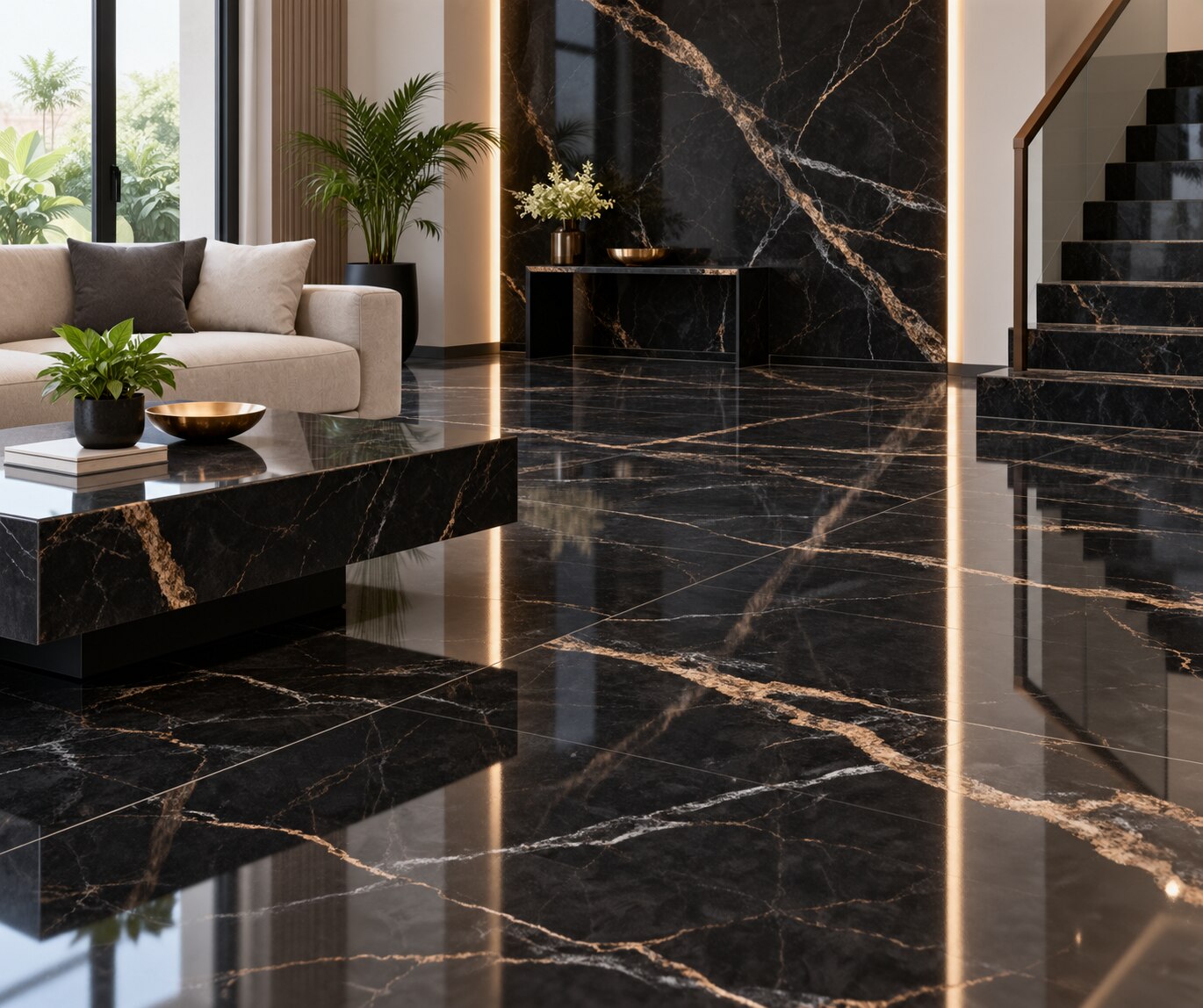
A quotation that says “Black Panther marble” does not identify the stone precisely, and a small showroom sample cannot reveal how an entire slab will look after cutting. By the end, you will know how to verify the material, inspect and reserve slabs, match the finish to each room, and compare its upkeep with other dark and light surfaces.
Key takeaways
- Confirm whether the stone is marble, quartzite, granite, or resin-filled.
- Inspect the entire slab and approve vein placement before cutting.
- Choose finishes according to heat, water, scratching, and etching risks.
- Compare alternatives and request material evidence from your supplier.
Confirm What “Black Panther” Means Before You Approve the Stone
“Black Panther” is a trade name, not a precise geological classification. Before approving the material, confirm whether it is calcitic marble, dolomitic marble, quartzite, granite, or a resin-filled commercial stone. The main black panther marble benefits are visual: a dark ground and contrasting veins create strong feature walls, vanities, staircases, and book-matched panels.
That contrast also exposes dust, water marks, scratches, chips, and uneven polishing.
For black panther marble in pune, verify the offered lot through these documents and checks:
1. Match the slab invoice, quotation, and product sheet. They must state the stone type, origin or quarry, thickness, calibration, and lot reference. If the invoice says granite while the quotation says marble, stop approval until the discrepancy is resolved.
2. Request recent laboratory data for water absorption, density, compressive strength, and flexural strength. Ask for acid-sensitivity information because marble can etch under lemon juice, vinegar, or acidic cleaners. ASTM C503/C503M helps assess dimension-stone requirements but does not guarantee the appearance of your lot.
3. Inspect the actual slabs under diffuse and raking light. Look for dominant white or gold mineral bands, open fissures, hairline cracks, resin-filled pits, edge damage, and repaired areas. A showroom sample can hide each one.
Approve the stone only after comparing the full lot with the intended application and recording the selected slab numbers. A dramatic surface is unsuitable if its repairs, acid reaction, or structural defects conflict with the project’s demands.
Inspect the Full Slab and Approve the Layout Before Cutting
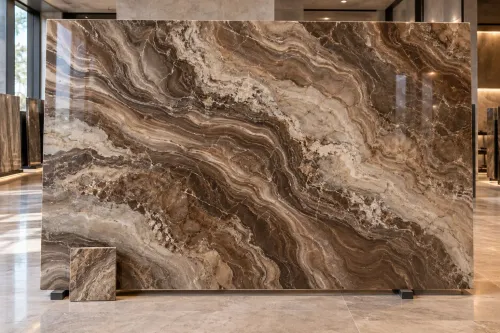
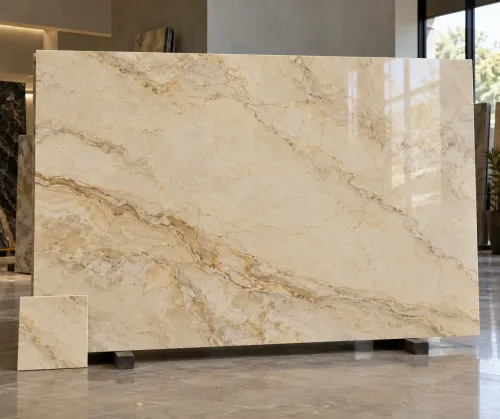
Approve a black panther marble slab only after examining its entire surface, not a showroom sample. A small sample can hide a dominant white vein, gold mineral cluster, resin repair, or polishing defect that will govern a large wall, counter, or staircase.
1. Check the slab under diffuse light and raking light. Look for uneven black colouring, white or gold mineral distribution, open fissures, hairline cracks, resin-filled pits, edge damage, dull patches, and repaired areas.
2. Compare several slabs from the available lot. Select pieces with compatible colour, vein direction, and pattern density, then reserve slabs from the same lot for adjoining surfaces. Different lots can make a single elevation look patchy.
3. Confirm the exact stone type on the invoice and product documentation. “Black Panther” is a trade name; the paperwork should identify whether the material is calcitic marble, dolomitic marble, quartzite, granite, or a resin-filled commercial variety.
4. Mark the visible faces on a slab-by-slab elevation or shop drawing before cutting. Place the strongest pattern where it will be seen, align veins across joins, and keep damaged or heavily repaired sections away from focal areas.
Poor layout becomes conspicuous on dark stone: a crooked vein, wide grout line, or adhesive squeeze-out stands out against black. Approve the cutting plan and finish on a representative full-size mock-up, because honed or leathered surfaces alter colour depth and reveal a different level of texture from polished stone.
Match the Stone and Finish to the Interior Application
The main black panther marble benefits are visual continuity and drama: a dark ground with contrasting veins can carry from a feature wall to a vanity face, staircase detail, or book-matched reception panel.
Use it where the surface is seen more than abused, because dust, dried water, scratches, edge chips, and uneven polishing stand out against black stone.
| Application | Suitability | Polished-finish problem |
|---|---|---|
| Feature walls and book-matched panels | Excellent for living rooms, reception areas, and hotel-style interiors | Reflected light exposes lippage, resin patches, and uneven polish |
| Kitchen backsplashes and reception counters | Strong choice where the stone provides visual contrast | Acidic splashes can etch the surface; heavy impact can chip exposed edges |
| Bathroom vanity faces and shower niches | Suitable for vertical surfaces and dry vanity areas | Water marks and cleaner residue become conspicuous |
| Stair treads and entry flooring | Use only with documented wet-slip planning and secure detailing | Monsoon water can make polished stone dangerously slick |
| Low-traffic decorative flooring | Works in controlled, dry interiors | Fine scratches and traffic paths become visible |
Do not treat sealing as an anti-slip treatment. In Pune bathrooms and entry zones, specify falls toward drains, waterproofing, grout detailing, and a finish suited to wet-foot traffic separately. A honed or leathered finish reduces glare and hides fine scratches, but it changes colour depth and perceived porosity, so approve a full-size mock-up.
Confirm adhesive limits, substrate flatness, movement joints, and mechanical restraint before fixing a heavy black panther marble slab.
Plan for Heat, Water Marks, Scratches, and Acid Etching
Dark polished stone shows every change in reflection, so small habits protect the visual continuity you approved. For black panther marble in Pune, plan for dust, monsoon moisture, cooking heat, and cleaning chemicals from the day of installation.
- Wipe spills immediately, especially lemon juice, vinegar, wine, coffee, and bathroom descalers. Acid can etch calcitic marble into a dull patch even after sealing.
- Clean with a pH-neutral, stone-safe cleaner and a soft microfiber cloth. Skip scouring powder, bleach, abrasive pads, and generic toilet cleaners.
- Dry vanity tops, shower ledges, and entry flooring after use. A squeegee reduces dried water marks, while mats outside wet zones limit grit and muddy footprints.
- Use chopping boards, coasters, and felt pads under objects. Dragged pottery, metal containers, and sand trapped under décor can create fine scratches.
- Put hot cookware on a trivet and let it cool before placing it on the stone. Direct heat and sudden temperature changes can stress the slab, damage resin repairs, or leave a visible change in polish.
Ask the installer which sealer suits the confirmed stone type and follow the stated reapplication test; sealing reduces absorption, but it cannot prevent acid etching or make a polished floor slip-resistant. Keep shower falls, grout joints, and waterproofing correctly detailed rather than treating sealer as a substitute.
Approve any honed or leathered finish on a full-size sample, because it changes colour depth and how marks appear.
Compare Alternatives and Ask the Supplier for Evidence
Judge the black panther marble benefits against the job, not the name on the quotation. Compare the actual slab with black granite, quartzite, and engineered quartz for stain resistance, scratch behaviour, acid sensitivity, heat exposure, pattern continuity, and maintenance.
Confirm the exact material—calcitic marble, dolomitic marble, quartzite, granite, or resin-filled stone—on the invoice and product documentation.
| Option | Strength to compare | Main risk or trade-off |
|---|---|---|
| Black Panther marble | Strong visual continuity for feature walls, vanities, stairs, and book-matched panels | Acid etching, visible scratches, water marks, fissures, and uneven polishing |
| Black granite | Hard-wearing choice for busy counters and high-contact areas | Veining and slab character may differ from the intended design |
| Quartzite | Natural stone appearance with higher resistance in demanding applications | Confirm that the supplied stone is genuine quartzite, not a mislabelled marble |
| Engineered quartz | Consistent colour and controlled pattern | Check heat limits and joint visibility before selecting it near cooktops |
Ask a black marble supplier in Pune for the quarry or origin, slab thickness, calibration tolerance, available dimensions, resin or repair disclosure, recent laboratory test data, and the exact lot you will inspect. View every candidate slab under diffuse and raking light; reject dominant unwanted veins, open fissures, edge chips, and obvious repairs.
Ask for the layout elevation before cutting.
RK GRANITE can support a useful comparison when it shows the offered lot beside alternatives rather than relying on a showroom sample. Approve the selected slabs, adhesive system, joints, and wet-area detailing in writing before fabrication.
Related product
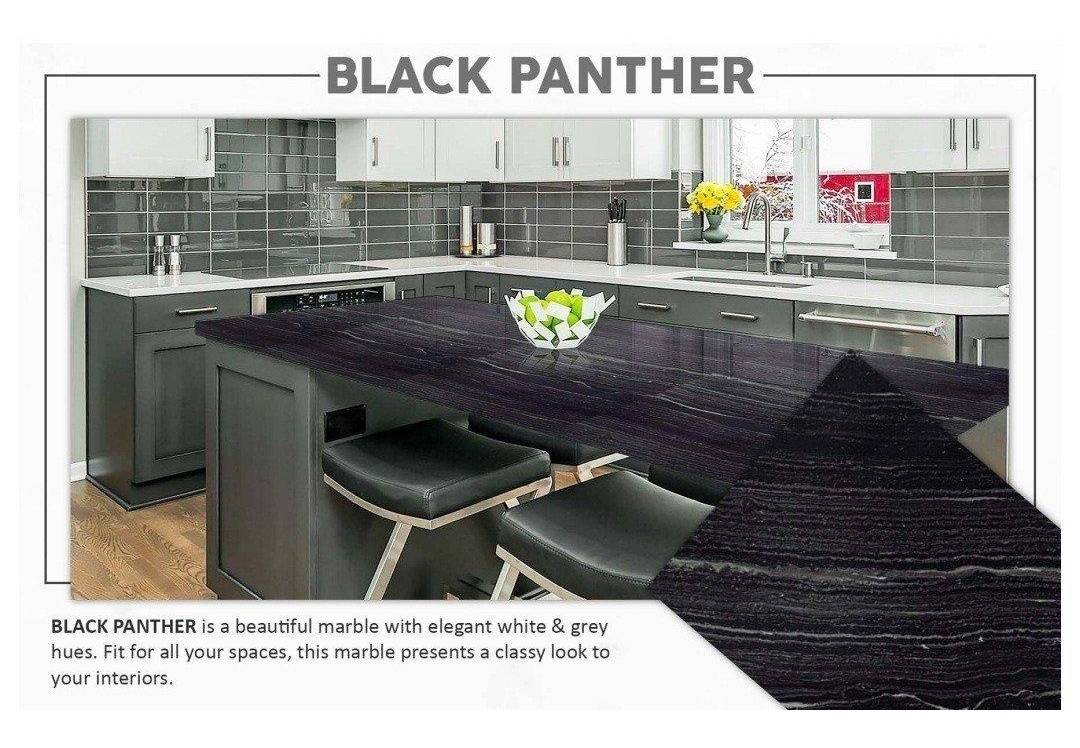 | Marble RK Granite offers premium Black Panther Granite in Pune, renowned for its deep black base with subtle white and gold specks, providing a bold and... View product → |
Frequently asked questions
What does “Black Panther” mean in marble?
Black Panther is a trade name, not a precise geological classification. Confirm whether the slab is calcitic marble, dolomitic marble, quartzite, granite, or resin-filled stone before approval.
Why inspect the full Black Panther marble slab before cutting?
The full slab reveals vein direction, colour variation, filled areas, and potential defects. Approve the layout before cutting to protect the intended book-match or feature-wall design.
Where can Black Panther marble be used indoors?
Its dark ground and contrasting veins suit feature walls, vanities, staircases, and book-matched panels. Match the finish and stone type to each application.
What damage should you plan for with Black Panther marble?
Plan for heat exposure, water marks, scratches, and acid etching. The risk depends on the stone’s composition, finish, location, and maintenance routine.
What should you ask a Black Panther marble supplier before buying?
Ask the supplier to identify the stone type, show the complete slab, explain its finish and care requirements, and provide evidence supporting the material description.
Keywords