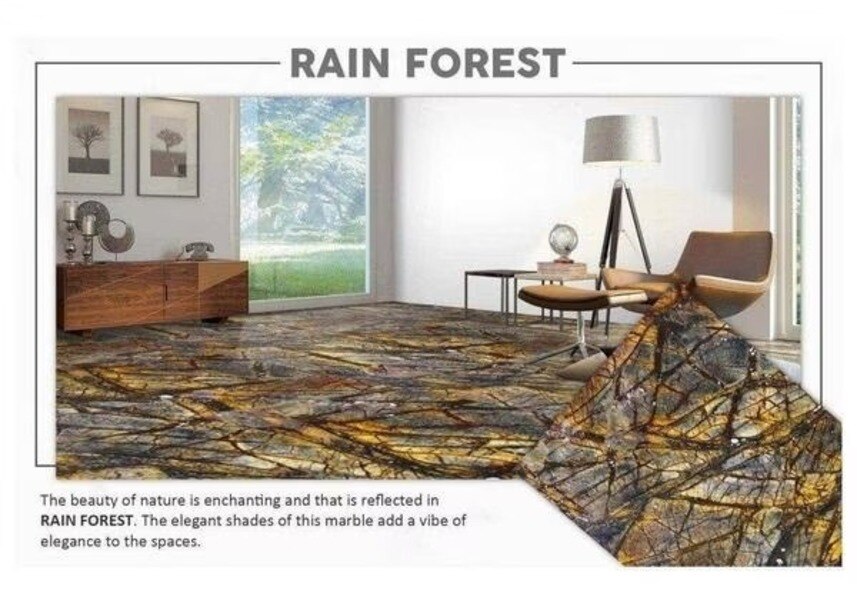
Rain Forest is sold under a commercial name that does not by itself identify its geology, performance, or suitability for a particular room. By matching the actual slab lot, finish, installation method, and maintenance demands to each Pune project, you can decide where its variation is an advantage and where a more predictable surface is the safer choice.
Key takeaways
- Match the slab’s pattern intensity to the room size and design.
- Approve the actual slabs, not only photographs or sample pieces.
- Set finish and performance limits before fabrication begins.
- Record slab details, quality checks and installation requirements in writing.
Match Rain Forest to the Project, Not Just the Appearance
Rain Forest suits projects where natural variation is the feature, not a defect. A useful framework for rain forest marble choices for different projects in pune is to match pattern, traffic and replacement needs before approving the colour.
Confirm whether the slab is documented as marble or granite; suppliers sometimes use both labels for visually similar material.
| Application | Fit | Better alternative when |
|---|---|---|
| Feature wall or staircase wall | Excellent for dramatic veining and bookmatching | Use porcelain or plain marble when future panel replacement must be inconspicuous |
| Living-room floor or low-traffic lobby | Suitable with a slip-conscious finish and accepted variation | Choose porcelain or consistent stone for heavy daily traffic |
| Kitchen backsplash, vanity or reception desk | Strong choice where selected slabs create a focal point | Choose engineered quartz when repeated colour and easier matching matter |
| Shower, wash area or balcony | Use only after absorption and installation checks | Choose a tested porcelain system when moisture risk and low maintenance dominate |
| Exterior façade, terrace or paving | Specify only after testing for weather, movement and slip performance | Choose an exterior-rated stone or porcelain system when exposure is severe |
Rain forest marble for interiors works particularly well in reception desks, selected stair elements, vanities and feature surfaces. It is a weaker choice for a large Pune office floor that needs uniform appearance, rapid replacement and simple maintenance.
Quartz offers predictable colour, but it is not automatically suitable for every exterior or high-heat location; check the manufacturer’s limits. A sealer reduces staining, not waterproofing failures, so shower and balcony details still need proper falls, joints and waterproofing.
Approve the Actual Slabs Before You Approve the Design
Approve the actual slab lot before approving a drawing: a polished tile or showroom chip cannot predict the colour, veining, fissures, or pattern direction across a wall, island, or staircase. That is the essential rule for Rain Forest marble selection in Pune.
1. Request photographs of every available slab laid in sequence under neutral white light, with lot identification visible. Prefer an in-person inspection of the full slabs.
2. Compare slabs from the same block. Record the background colour, vein density, direction, open pores, resin-filled fissures, and visible patches; do not assume adjacent slabs will match.
3. Wet a small, approved area to compare the dry and damp colours. Reject slabs with unacceptable darkening, edge chips, warping, or repairs on the face.
4. Check the reverse for resin, fiberglass mesh, patches, and reinforcement. Confirm nominal and minimum thickness, because the common 18–20 mm specification does not guarantee the finished thickness after calibration.
5. For book-matching, approve the slab order, polishing direction, grain flow, and cut sequence together. A symmetrical mirror image is impossible when the sequence or backing prevents it.
6. Mark kitchen cut-outs, edge radii, underside reinforcement, and seam positions on the selected slabs before fabrication. This exposes fissures and marks that could become prominent around sinks and hobs.
7. For shower, balcony, or wash-area use, test the actual slab’s absorption and verify falls, joints, waterproofing, and movement joints. Sealer reduces staining; it does not waterproof the assembly.
Document these approvals for the Rain Forest marble slabs in Pune before CNC cutting or dispatch.
Choose the Finish and Set Practical Performance Limits
Polished stone delivers the strongest colour contrast, but it also exposes scratches, uneven resin filling, water marks and soap residue. For rain forest marble for interiors, choose honed or leathered surfaces where glare, slipping and daily contact matter more than maximum colour depth.
| Application | Suitable finish | Practical performance limit |
|---|---|---|
| Living-room or low-traffic floor | Honed or leathered | Accept natural variation and schedule prompt cleaning of grit; avoid using it as a uniform finish across heavy-traffic commercial areas. |
| Feature wall, backsplash or reception desk | Polished, honed or leathered | Polished suits dramatic colour; inspect resin-filled fissures and keep replacement slabs from the same block. |
| Bathroom wall or vanity | Honed or polished | Seal the surface and wipe water and toiletries promptly; polished stone is unsuitable as the default shower-floor finish. |
| Shower or bathroom floor | Small calibrated pieces with a honed texture | Provide a proper slope and drainage; do not rely on polish for wet traction. |
| Kitchen counter | Honed or polished | Control acidic foods and cleaners, approve cut-outs and edge protection, and expect possible staining at resin-filled fissures. |
| Stair elements or office flooring | Honed or leathered | Use only where traffic is moderate and edge damage can be controlled. |
Set a maintenance limit before ordering:
- Remove sand and grit with a soft broom or vacuum, then use a pH-neutral stone cleaner.
- Do not use lemon, vinegar, toilet cleaner or abrasive powder; acids etch marble.
- Reseal according to the sealer maker’s instructions, and test water absorption on an offcut before treating the installed surface.
- Reject polished stone for a wet floor if the design cannot provide smaller pieces, safe texture and reliable drainage.
Plan Fabrication and Installation Around the Stone
A nominal 18–20 mm slab does not guarantee a 18–20 mm finished edge. Before CNC cutting begins, resolve thickness variation, warping, filled fissures, open pores, edge chips, and any resin or fibreglass mesh on the rear of Rain Forest marble slabs in Pune.
1. Approve the fabrication drawing against the actual slab layout. Mark vein direction, joins, book-matched faces, sink and hob cut-outs, tap holes, service openings, edge profiles, corner radii, overhangs and support locations. For a kitchen island, also specify underside reinforcement and inspect the areas around every cut-out, where handling damage and visible marks are concentrated.
2. Confirm the installation substrate before delivery. Check wall or floor flatness, joint positions, movement joints, falls and waterproofing; around a shower, balcony or wash area, test the actual slab for absorption. Sealer reduces staining but does not waterproof the assembly or correct moisture moving through a defective substrate.
3. Set the bathroom cleaning method in writing. Use a neutral-stone cleaner and a test patch, because acidic descalers, toilet cleaners and cement-removal chemicals can etch the finish or create marks mistaken for stone staining.
4. Plan handling and site protection. Confirm slab dimensions, lifting access, packing, dry storage, adhesive compatibility and curing time before installation. Rain Forest marble for interiors deserves protection from cement haze, metal contact and impact until adjacent work is complete.
Specify the Material and Supplier With Measurable Checks
Before placing an order, make the supplier’s description measurable: confirm the stone identity, actual slab lot, dimensions, condition, test data and delivery responsibility in writing.
1. Ask whether the product is Rain Forest marble, Rain Forest granite, or a commercial name for serpentinite-rich stone from Rajasthan. Record the quarry or origin and request a petrographic description; “premium” and “imported” prove nothing.
2. For Rain Forest marble selection in Pune, approve photographs of every available slab laid out in sequence under neutral light, with each slab’s lot number visible. Confirm background colour, vein direction, book-matching sequence and usable dimensions, not just a showroom chip.
3. Record nominal and minimum thickness, thickness variation, warping, edge chips, filled fissures, open pores and repairs. Check the reverse for resin or fiberglass mesh before approving CNC cutting, thin edges or complex profiles. A supplier such as RK GRANITE should identify these conditions before fabrication begins.
4. Request water-absorption and weathering data for exterior areas, plus the proposed finish and fixing method. For a façade, terrace or paving, confirm anchoring, drainage and staining risks; “outdoor grade” is not a test result.
5. For a shower, balcony or wash area, ask for absorption data and sealer details, but do not treat sealer as waterproofing. Confirm that the project includes a waterproof substrate, falls, sealed joints and movement joints.
6. Put packing, transport, inspection on arrival, breakage replacement and the named fabricator or installer in the quotation. Do not release payment until the delivered lot matches the approved photographs and recorded measurements.
Related product
 | Marble RK Granite offers premium Rain Forest Granite in Pune, known for its rich green base with intricate brown, gold, and black patterns, giving interiors... View product → |
Frequently asked questions
How do you match Rain Forest marble to a Pune project?
Assess pattern intensity, room size, traffic, moisture exposure and future replacement needs before approving the colour or layout.
Why should you approve the actual Rain Forest marble slabs?
Natural stone varies between slabs, so inspect the exact slabs for colour, veining, cracks, filled areas and usable dimensions.
Which finish and performance limits should you specify?
Choose the finish according to use and maintenance tolerance, then set clear limits for slip risk, staining, edge damage and surface variation.
What should fabrication and installation planning include?
Plan cuts around the slab pattern, confirm seam locations, allow for handling, and use installers experienced with natural stone.
How can you compare Rain Forest marble suppliers in Pune?
Request slab identification, dimensions, invoices, inspection records and written details of fabrication, installation and replacement responsibilities.
Keywords